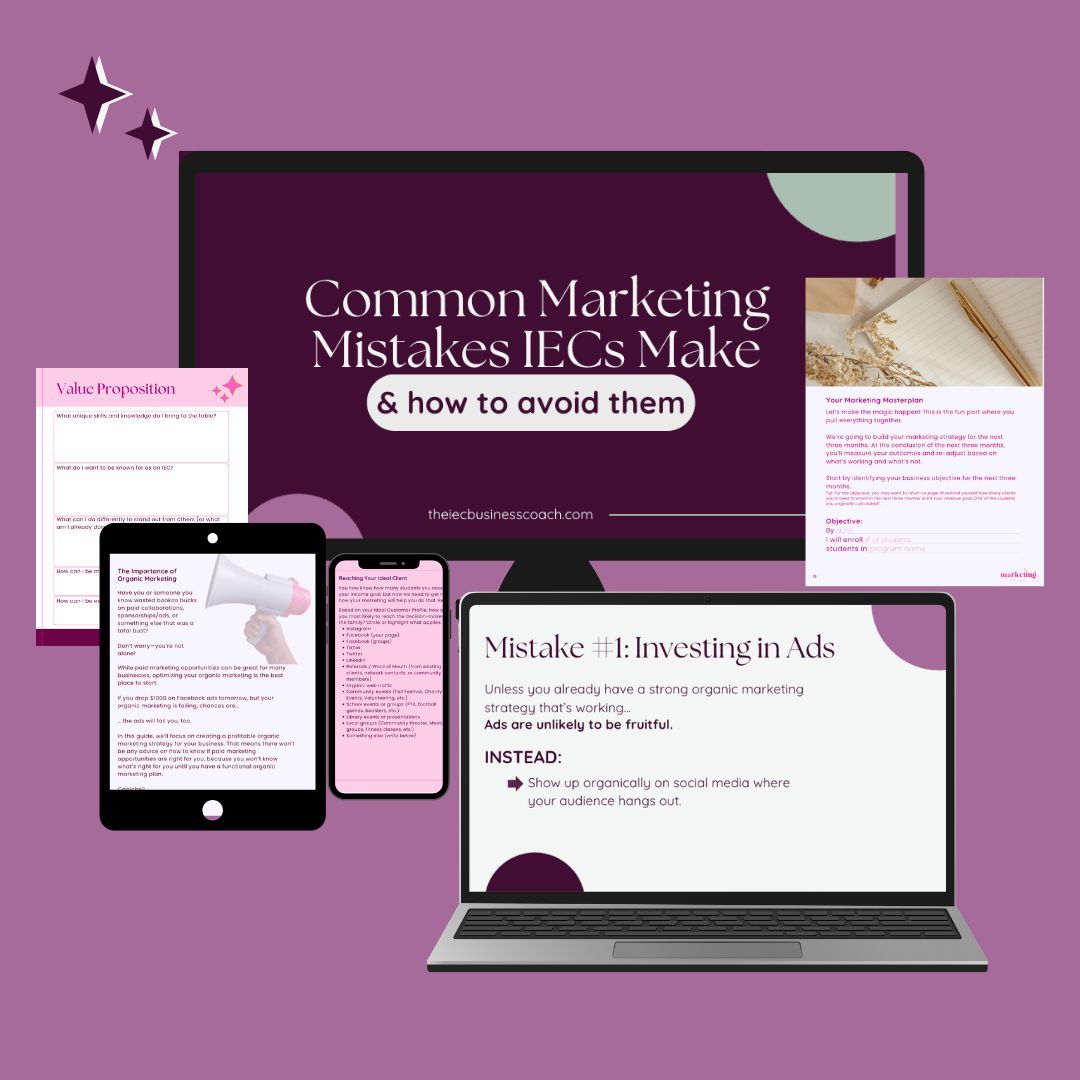
Why Running Ads Is the Most Costly Marketing Mistake IECs Make
Apr 15, 2026
Let me paint you a picture.
You've been trying to grow your IEC practice. You've heard that running ads is a great way to get in front of more families. So you set up a Facebook or Instagram ad, put a few hundred dollars behind it, and wait. And wait. And... crickets.
Sound familiar? You are not alone. This is one of the most common — and most expensive — mistakes I see independent educational consultants make. And I want to explain exactly why it happens, because it's not bad luck, and it's not that ads "don't work." It's that there's a very specific order of operations when it comes to marketing, and ads come later in that sequence than most people think.
Why Ads Feel Like a Cheat Code (And Why They're Not)
Ads are appealing because they feel like a shortcut. You pay money, you get in front of more people, more people book calls with you. Simple, right?
Except it doesn't work that way — not if the foundation isn't there first.
Here's the thing about ads: they amplify what's already working. If your messaging is clear, your niche is defined, and you already know what kind of content resonates with your ideal client, then yes, ads can pour gasoline on that fire and accelerate your growth. But if you haven't figured any of that out yet? Ads are just going to spend your money faster on something that wasn't working to begin with.
Think about it this way: an ad is just a piece of content with a budget behind it. If the content isn't connecting with people organically, paying to show it to more people isn't going to fix the disconnect. You'll just reach more people who aren't interested.
The Real Problem Ads Can't Solve
When I work with IECs who've tried ads and gotten burned, we almost always uncover the same root issue: the messaging wasn't right yet.
Maybe it was too broad — trying to appeal to every kind of family instead of speaking directly to a specific type. Maybe it was too focused on the IEC's credentials instead of the family's situation. Maybe the hook wasn't strong enough to stop someone from scrolling. Whatever the issue, putting money behind it doesn't solve it. It just makes the problem more expensive.
Before ads can work for you, you need to have already figured out:
- Who you're talking to. Not "families with college-bound students" — that's everyone. I mean the specific type of family that is a perfect fit for you. The ones who light you up, who value what you do, who are the easiest and most enjoyable to work with. Do you know exactly who that is? Can you describe them in detail?
- What actually resonates with them. You need to have tested enough content, sent enough emails, had enough conversations to know what kinds of messages make your ideal client stop and say "yes, this is exactly what I need." You can't know that without doing the organic work first.
- A clear offer that converts. If families are landing on your website or your profile after seeing an ad and then not taking action, the ad did its job — but something in your funnel is broken. That's not an ad problem. That's a messaging or offer problem.
None of these things can be solved by throwing money at ads. They get solved by doing the organic work first.
What Organic Marketing Actually Does for You
I know "organic marketing" can sound like a lot of work, especially when you're already busy running your practice. But here's what it actually buys you that ads can't.
- It teaches you what works. When you show up consistently on Instagram, send a regular newsletter, or do a webinar for local families, you learn in real time what resonates. Which posts get saved. Which subject lines get opened. Which messages prompt families to reach out. That information is gold — and it's something you can only get by doing the work.
- It builds trust before someone ever gets on a call with you. College consulting is a high-trust, high-investment service. Families aren't going to hand over thousands of dollars to someone they just found in an ad. They want to feel like they already know you, already trust your expertise, already believe you're the right fit. Consistent organic presence builds that. Ads alone don't.
- It gives you something worth amplifying. Once you've built the organic foundation — once you know what your audience responds to and your messaging is dialed in — then you can run ads. And when you do, they'll actually work.
One of my clients had around 500 Instagram followers when she started promoting her upcoming webinar. She hadn't even emailed her list yet. She was just showing up consistently on social media with content that spoke directly to her niche. Before she ever sent a single email, she had over 40 people registered for her webinar. That's what a solid organic strategy can do — and it didn't cost her a cent in ad spend.
So When Should You Run Ads?
Ads are not forever off the table. They can absolutely be part of your marketing strategy — eventually. Here's how I think about the right time to introduce them:
You're ready to run ads when you can answer yes to all of these:
- You have a clearly defined niche and you know exactly who your ideal client is
- You have content that you already know performs well organically
- Your website converts — meaning when people land on it, they take action
- You have a strong sales process so that when leads come in, you can close them
- You have some budget to invest and you're not expecting ads to be your only source of leads
If you can check all of those boxes, then yes — ads can accelerate what you've already built. But they're not a substitute for the foundation. They never were.
The Mistake That Costs More Than Money
Here's what I really want you to hear: the cost of running ads too early isn't just the money you spend. It's the discouragement that follows.
When IECs spend money on ads and get nothing back, they often walk away thinking "marketing doesn't work for me" or "my business just isn't the kind of thing you can market online." That's not true. What didn't work was ads — at that specific point in time, without the right foundation in place. But that conclusion — that marketing doesn't work — can keep someone from trying again for months. And that is a much bigger cost than a few hundred dollars.
You can market your IEC business. It can work. It does work — for my clients, consistently. But it works because they build the right things first.
Where to Start Instead
If you've been tempted to run ads, or you've already tried and been disappointed, here's what I'd focus on instead right now:
Get clear on your niche. If you're not sure who you're talking to, everything else is going to feel harder than it needs to.
Pick one platform and commit to showing up there consistently. For most IECs, that's Instagram. Learn how the platform works, study what performs well, and give yourself permission to not be perfect at it from day one.
Start your email list. If you don't have one, start one. If you have one that you haven't emailed in months, start there. Email is one of the highest-converting marketing channels available to you, and it's completely free.
Do all of that consistently for 60 to 90 days, and you'll have learned more about what works for your specific business than any ad could have told you — for a lot less money.
You Don't Have to Build Your IEC Business Alone
You're an expert in college admissions. But building a profitable IEC practice requires marketing strategy, sales systems, and structure — and that's a completely different skill set.
If you're serious about growing your business and getting clients consistently, the fastest path forward is following a proven system instead of guessing your way through it. You don't need another certification. You need better systems. And you can build this faster than you think.
Growth Generator is my six-month group coaching program built specifically for IECs. Inside, you'll get:
- A self-paced course with 70+ lessons, resources, and templates
- Weekly group coaching calls with me, mastermind-style
- Daily access to me and my team so nothing slows your momentum between calls
- A guaranteed return on your investment — if you don't see ROI in our six months together, I'll keep working with you until you do
If any part of this resonated, the next step is simple: watch a free video overview of how Growth Generator works and see if it's the right fit for where you are right now.