Why Your IEC Business Isn't Growing (Exposing the Biggest Marketing Mistakes IECs Make)
Apr 08, 2026
You're good at what you do. Like, really good.
You know college admissions inside and out. You know how to guide a student through the process, how to help them find schools that are actually a fit, and how to make sure they're not leaving anything on the table. Families who work with you are better off for it — and you know that.
So why is growing your business so hard?
Here's the truth nobody really wants to say out loud: being an exceptional IEC and being good at marketing your IEC practice are two completely different skill sets. And most IECs — even the really experienced ones — are making the same handful of marketing mistakes that are quietly keeping their caseload smaller than it should be.
I've worked with dozens of IECs, and before that, I spent years in marketing helping startups scale and building departments that moved the needle for small businesses. I also worked at Collegewise from 2019 to 2022, which means I've seen this industry from the inside. I know what works for IECs. I know what absolutely does not. And I know that a lot of the generic small business marketing advice out there just doesn't translate to what you're doing.
So let's get into it. Here are the 10 biggest marketing mistakes I see IECs make — and what to do instead.
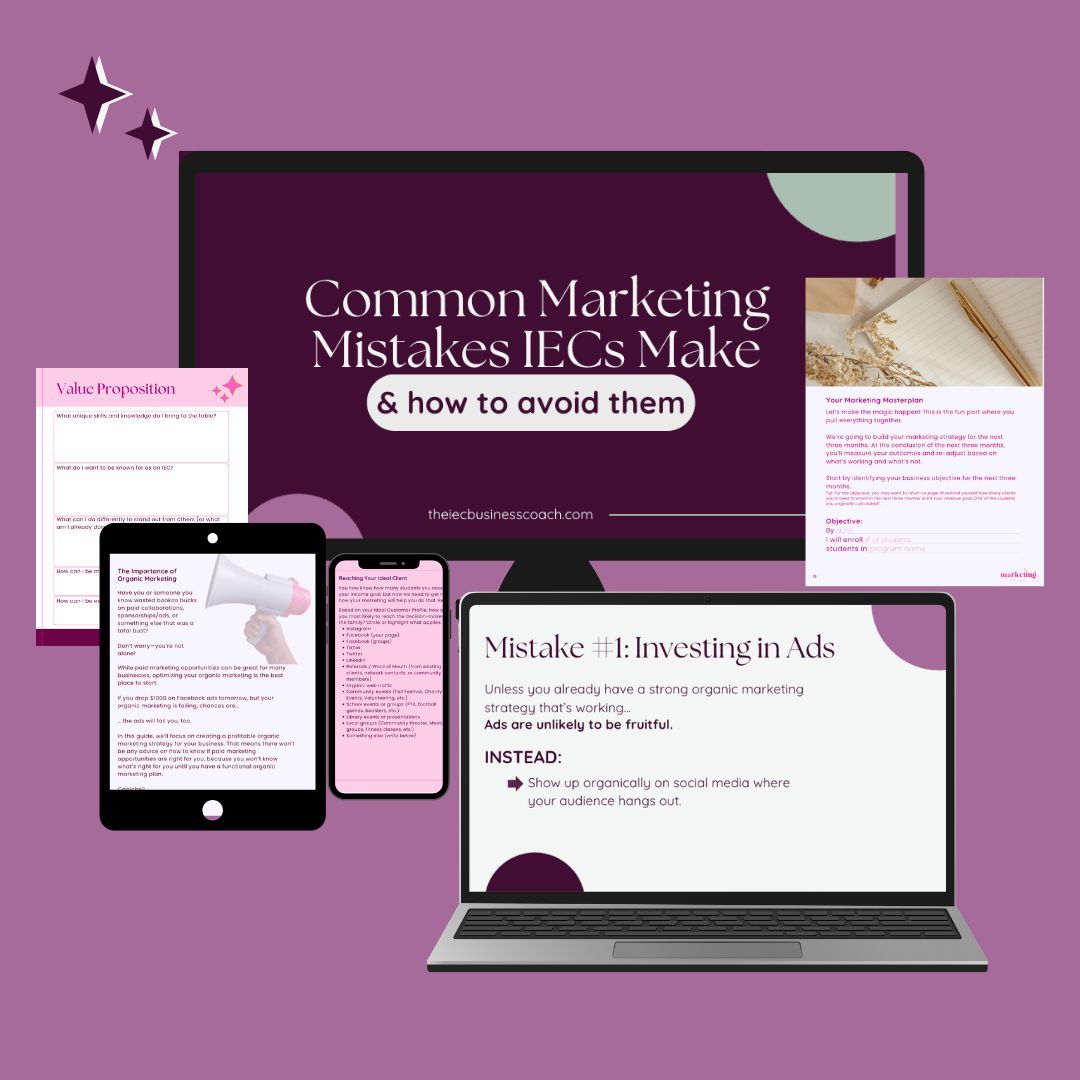
Mistake #1: Investing in Ads Before You're Ready
Ads feel like a shortcut. I get it. You put some money behind a Facebook or Instagram ad, sit back, and wait for the leads to roll in. Except they don't. And you've just flushed a few hundred dollars (or more) down the drain.
Here's the thing: unless you already have a strong organic marketing strategy in place, your ads are almost certainly going to fail. Why? Because ads amplify what's already working. If you haven't figured out how to talk to your ideal client in a way that resonates — messaging that actually lands — putting money behind it isn't going to fix that. It's just going to make the ineffective thing more expensive.
I have clients who, before they came to me, had spent hundreds of dollars on ads with nothing to show for it. And when we looked at their messaging together, it became clear pretty quickly why it wasn't working. The message wasn't right yet. Ads wouldn't have saved it.
What to do instead: Focus on organic first. Show up consistently on the platform where your audience actually hangs out (more on that in a minute), learn how to talk to them in a way that resonates, and build something that's working before you put dollars behind it. One of my clients had 500 followers and no email list when she started promoting her webinar organically on social media. She had over 40 registrations before she ever sent a single email. That's the power of getting the organic foundation right first.
Mistake #2: Marketing to Everyone (Which Means Marketing to No One)
This one hits a nerve for a lot of IECs, so I want to be gentle about it — but I also can't let you keep making this mistake.
There are 25,000 IECs in the world. That number is growing. The industry is more competitive than it's ever been, and families have more options than ever. If your marketing is broad and vague — if you're trying to appeal to every type of student and every type of family — you are going to get lost in the noise.
I know the fear. If I niche down, what if I miss someone? What if I'm leaving clients on the table?
Here's the reframe: specificity doesn't shrink your market. It activates the right people in it.
Picture a mom sitting in the carpool line, scrolling through Instagram Reels while she waits. She scrolls past a post about how to write a strong college essay. Great content — she saves it, maybe follows you. Then she scrolls again and sees a post specifically for students applying to performing arts programs in college, with specific things they need to keep in mind. Her kid wants to pursue performing arts.
Her reaction to that second post is completely different.
That's my kid. I need to follow this person. I need to book a call with them.
That's what specificity does. It creates that "this is exactly for me" feeling — and that's what turns followers into clients.
What to do instead: Get clear on your secret sauce. If it's hard to figure out what you specialize in, start by thinking about who you don't work with. What skill sets do you lack? What types of students are you not the best fit for? From there, think about the clients you've loved working with most. What do they have in common? That's your niche.
Mistake #3: Having an Email List You Never Use
When I ask IECs if they have an email list, most of them say yes. When I ask when they last sent something, the answers get a lot quieter.
Here's the deal: an email list you don't use is not a marketing asset. It's just a spreadsheet. Email is one of the most effective marketing tools available to you — it's direct, it's personal, and it lands in someone's inbox rather than hoping the algorithm shows it to them. But only if you actually use it.
The good news is that getting started is way simpler than most people think. You don't need a fancy sequence or a perfectly designed newsletter. You just need to start.
What to do instead: Set up a free MailerLite account (10 minutes, tops), and send your first newsletter. Pull from existing content — answer a question a family asked you on a recent call, share a trend you're watching in college admissions, or give families a heads up about why starting now beats waiting until August. Add a line at the end mentioning you have spots open on your roster. That's it. That's a newsletter. Build the habit first, then refine it.
Mistake #4: Treating Sales Calls Like Networking Calls
Marketing and sales are not the same thing, but they are connected. You can have the best marketing strategy in the world, but if you can't close on a sales call, it doesn't matter.
A lot of IECs hate feeling "salesy." I hear this constantly. And I want to say something that I genuinely believe: on your salesiest day, you are not the car salesman or the pushy influencer you're picturing. That's not you. But the discomfort around sales is still holding a lot of IECs back from growing their business.
A strong sales call isn't a get-to-know-you chat. It has structure. It has intention. And it has a clear outcome.
What to do instead: Start with a strong intake questionnaire that helps you qualify the family before you ever get on a call. If you see a red flag — a family that's hyper-fixated on getting into a top-10 school when that's not your wheelhouse, for example — address it. Don't waste your time or theirs. Then, when you get on the call, open with what I call an upfront contract: here's how this call is going to go, here's what we're going to cover, does that work for you? This gives the call structure and keeps you in the driver's seat. And when it comes time to pitch, recommend one specific program — not five options. Families don't know what they need. That's why they're talking to you.
Mistake #5: A Weak (or Nonexistent) Referral Strategy
Referrals are great. I love referrals. But if referrals are your only lead source, you are one slow season away from a real problem.
I talk to IECs all the time who say, "I used to get so many referrals, but this year it's just dried up." And my first question is always: are you actually asking for them? Because most people aren't. They're hoping referrals will happen organically, and sometimes they do — but hope is not a marketing strategy.
What to do instead: Have a template ready to go. When a family emails you with good news — a college acceptance, a decision made — respond warmly, congratulate them, and then ask. Something simple: "As a reminder, I still have a few spots open for the Class of 2027. If you know any families who could use support, I'd love an introduction." That's it. Have it written and ready so you're not staring at the screen trying to figure out how to phrase it in the moment. And beyond referrals, make sure you're building other lead sources so that when referrals slow down, you're not scrambling.
Mistake #6: Inconsistent (or Nonexistent) Social Media
I always tell my clients: you don't have to be on social media. But my most successful clients embrace it. Every single time.
The mistake isn't just not posting — it's posting without a strategy. Sharing random things here and there, going weeks without posting, showing up only when you remember. That's not going to move the needle.
Social media — specifically Instagram — is where your ideal clients are hanging out right now. Parents are on it. They're scrolling. They're looking for advice. And when they find an IEC who speaks directly to their situation, they follow, they save, they reach out.
One of my clients, Katie, started with 250 Instagram followers. She committed to showing up consistently — posting every day, using strong hooks, creating content specific to her niche. One year later, she now has over 8,000 followers and is consistently converting them into clients. That's not magic. That's showing up.
What to do instead: Pick one platform and commit to it. For most IECs, that's Instagram. Post consistently — daily if you can build up to it, but at minimum a few times per week. Focus on content that speaks to your niche, answers real questions families are asking, and uses hooks that actually make people stop scrolling. "My review of UCLA" is going to lose people immediately. "3 things I saw on my UCLA visit that I never expected" is going to make people stick around.
Mistake #7: An Outdated Website
Your website is doing work (or not doing work) 24 hours a day. It's often the first place a family lands after hearing about you, and if it's outdated, cluttered, or full of copy that talks about you instead of them, you're losing clients you don't even know you're losing.
The most common mistake I see on IEC websites is too much "I." I will help you. I offer. I have experience. Families don't care about you yet — they care about what's possible for their kid. Flip the script.
Instead of "I will help you submit a strong college application," try "Submit a college application you're proud of." See how that immediately speaks to the person reading it? That's the shift.
What to do instead: Audit your website copy and remove I-statements wherever possible. Keep it concise — less is more, even when you have a lot to say. Get real photos if you can, and if you're using stock imagery, use Pexels or Unsplash instead of the very-obviously-staged Canva options. And if building or redesigning a site feels overwhelming, there are people on Fiverr who can build you a solid one for a couple hundred dollars. Think about what your time is worth.
Mistake #8: Overthinking Everything
This one is personal for me because I see it slow down so many brilliant people.
If you've ever spent four hours on one Instagram post, we need to talk. If you've been sitting on a newsletter idea for three weeks because it's "not ready yet," I'm talking to you. If there's a piece of content in your drafts that has been through seventeen rounds of revisions, please, for the love of all things, post it.
Done is better than perfect. Always. A post that goes out and gets seen by 20 people is infinitely more valuable than the perfect post that's still sitting in your drafts.
What to do instead: Give yourself a time limit. 30 minutes to write the post, then it goes out. Treat your content like a test, not a performance — you're learning what resonates, and you can't learn that until you actually publish something. Messy action almost always beats perfect inaction.
Mistake #9: Trying to Do Everything at Once
I love IECs. You are, without exception, some of the most intellectually curious, driven people I have ever met. You love to learn. You love to try new things. And that same quality that makes you great at your job is also the thing that makes you do ten marketing tactics at 50% capacity instead of two things really, really well.
Consistency is hard when you're spread thin. It's a lot more manageable when you're focused.
What to do instead: Pick one to three marketing tactics and commit to mastering them before you add anything else. For a lot of my clients, that means Instagram, an email newsletter, and one community relationship they can deepen. That's it. Not Instagram, Facebook, LinkedIn, TikTok, AND a podcast AND a blog AND a YouTube channel. Pick your things and own them.
Mistake #10: Taking Advice from People Who Don't Understand Your Industry
There is no shortage of marketing advice out there. Jenna Kutcher, Amy Porterfield, every business coach on Instagram — they all have great things to say. But here's the problem: a lot of that advice is built for a totally different kind of business, and applying it wholesale to your IEC practice is going to lead to a lot of wasted time and frustration.
IECs face unique challenges. You're either in a market that's oversaturated with other consultants, or you're in a market where families have no idea what an IEC even is. You're marketing to parents but working with students. You're selling a high-trust, high-investment service that requires relationship-building before anyone hands over a check. The playbook for a digital product seller or an e-commerce brand does not apply to you.
What to do instead: Find someone who actually understands your industry and learn from them. A cohesive, industry-specific strategy will always outperform a collection of generic tactics you've stitched together from ten different sources. When I finally invested in business coaching that was actually tailored to what I was building, everything changed. The same is true for the IECs I work with.
The Bottom Line
None of these mistakes mean you're doing something wrong as an IEC. They mean you're doing what almost everyone does when they're trying to build a business without a clear roadmap — throwing things at the wall, following generic advice, and hoping something sticks.
The good news is that every single one of these mistakes is fixable. And you don't have to figure it out alone.
You Don't Have to Build Your IEC Business Alone
You're an expert in college admissions. But building a profitable IEC practice requires marketing strategy, sales systems, and structure — and that's a completely different skill set.
If you're serious about growing your business and getting clients consistently, the fastest path forward is following a proven system instead of guessing your way through it. You don't need another certification. You need better systems. And you can build this faster than you think.
Growth Generator is my six-month group coaching program built specifically for IECs. Inside, you'll get:
- A self-paced course with 70+ lessons, resources, and templates
- Weekly group coaching calls with me, mastermind-style
- Daily access to me and my team so nothing slows your momentum between calls
- A guaranteed return on your investment — if you don't see ROI in our six months together, I'll keep working with you until you do
If any part of this resonated, the next step is simple: watch a free video overview of how Growth Generator works and see if it's the right fit for where you are right now.